


The DOMOVA team was invited to take part in the Ukraine Recovery Conference 2026 in Gdańsk, held on 25–26 June 2026 and jointly organised by the governments of Poland and Ukraine. For us, this was not just attendance at an international event, but a working trip with a clear focus: the recovery of Ukrainian cities, the attraction of private capital, and the search for practical mechanisms to address old, unsafe, and damaged housing stock.
The scale of this year’s conference speaks for itself. According to various estimates, around 7,500 participants gathered in Gdańsk, including nearly 70 official delegations and representatives of approximately 40 countries at the governmental level. The conference was opened by Prime Minister of Poland Donald Tusk and Prime Minister of Ukraine Yuliia Svyrydenko. President of the European Commission Ursula von der Leyen and German Chancellor Friedrich Merz also confirmed their participation. Over the two days, nearly 200 agreements, memoranda, and letters of intent were signed, with a total value exceeding EUR 1.5 billion.
URC2026 once again demonstrated that there is strong interest in Ukraine. International businesses, funds, chambers of commerce, public institutions, and investors are ready to consider cooperation opportunities. But almost all of them are saying the same thing: they need not general ideas, but specific projects with clear economics, a transparent legal structure, and a real implementation mechanism.
This is exactly the direction in which our team worked during the conference.
Urban recovery requires more than funding
At URC2026, there was much discussion about financing, investment, international programmes, and support for Ukraine. For example, under the Ukraine Investment Framework, EUR 524 million was mobilised for municipal projects, with an additional EUR 149 million directed to transport infrastructure development. A memorandum was also signed between Ukraine, the European Commission, and the European Investment Bank, opening the way for an additional EUR 120 million for transport, energy, and digital infrastructure.
However, our main conclusion is very practical: money alone does not launch recovery.
For private capital to enter a project, an investor needs to understand:
- what specific asset or project is being proposed;
- what its economics are;
- what legal risks exist;
- who is responsible for implementation;
- how cooperation with the city, the community, and property owners is structured;
- what result can be achieved.
Without this, even a strong idea remains only an idea.
For Ukrainian cities, this is especially relevant. Many assets that require renewal have complex ownership structures, technical issues, social sensitivity, and legal limitations. These are not projects that investors can enter quickly or without preparation.
What we discussed at URC2026
During the conference, the DOMOVA team held a number of working meetings with representatives of international business, institutions, and organisations working on Ukraine’s recovery.
We presented our approach to old and damaged housing stock and discussed how such projects can be prepared for investors. These conversations confirmed an important market need: international partners are ready to consider real projects, but only if they have a clear economic rationale, legal logic, and a transparent implementation mechanism.
It is also significant that the municipal level received separate attention this year. Oleksii Kuleba, Deputy Prime Minister for Restoration of Ukraine and Minister for Communities and Territories Development of Ukraine, noted that the conference showed a transition from responding to the consequences of war to long-term reconstruction planning. A portfolio of public-private partnership projects with an estimated value of EUR 5–10 billion was also presented at the event. Mykolaiv, in particular, presented its recovery experience at the conference and was among the cities whose practical cases investors studied most closely.
In other words, the market is not looking for abstract opportunities. It is looking for projects that can be verified, assessed, financed, and implemented.


Public-Private Partnership as one of the key instruments
One of the important topics at URC2026 was public-private partnership.
For urban recovery, this instrument is highly relevant. State and local budgets will not be sufficient to address all reconstruction needs. At the same time, private capital cannot work effectively where there are no rules, structure, or accountability.
The role of local self-government was also emphasised at the European level. Mayor of Gdańsk Aleksandra Dulkiewicz stressed that Ukraine’s recovery cannot be managed only from offices in capital cities, and that the success of transformation depends on trust — between central and local authorities, between the state and citizens, and between Ukraine and its European partners. The same point was discussed ahead of the conference during consultations involving Deputy Minister for Communities and Territories Development Oleksii Riabikin and representatives of the European Committee of the Regions.
This is why public-private partnership is viewed as one of the mechanisms capable of bringing together the interests of communities, the state, businesses, and investors.
But there is an important point here: international investment can enter municipal projects only when those projects are properly prepared. This is not just about a presentation or an idea, but about legal, economic, and organisational structuring.
For DOMOVA, this logic is very close. We work precisely with the types of assets where the process simply does not move forward without preparation.
Why housing stock is part of economic recovery
Old, unsafe, and damaged housing stock is often perceived as a social or municipal problem. In reality, however, it is also an economic issue. It is no coincidence that, among the key outcomes of URC2026 in Gdańsk, new housing programmes were highlighted alongside investments and digital tools for reconstruction.
Such buildings occupy urban land, shape the appearance of districts, and influence residents’ safety, infrastructure, and the investment attractiveness of entire areas.
The challenge is that a single building may have dozens of owners. Each of them has their own position, circumstances, and expectations. For a developer or investor, this creates a complex process. For the city, it becomes a problem that can remain unresolved for years. For residents, it means living in uncertainty.
That is why a mechanism is needed to help unite owners, form a clear asset, and make it suitable for further work with an investor or developer.
DOMOVA is working to make complex assets within old, unsafe, or damaged housing stock understandable for all parties.
For owners, this is an opportunity to exit a problematic asset through a collective decision. For developers and investors, it is an opportunity to work not with a chaotic set of individual apartments, but with a prepared asset and a clear process. For the city, it is a chance to receive new construction, renewed urban areas, and more efficient use of land.
This is the approach we discussed during URC2026. And it is precisely this approach that, in our view, can become part of a practical model for urban recovery.
What the trip confirmed
URC2026 confirmed several important points:
- First, international interest in Ukraine exists, and the scale of this year’s conference — thousands of participants, dozens of delegations, and nearly 200 signed agreements — clearly demonstrates this.
- Second, investors are ready to discuss specific projects, but they want to see a prepared structure, clear economics, and understandable rules.
- Third, municipal projects have significant potential. This year, hundreds of millions of euros were allocated specifically to them, and a public-private partnership portfolio worth billions was presented. However, such projects require high-quality preliminary preparation.
- Fourth, housing recovery cannot be considered separately from urban development, investment, and partnership with the private sector.
After the conference, we continue working with the contacts established during the trip and on preparing projects that can be understandable for international partners and private investors.
Ukraine’s recovery is not only about major international programmes. It is also about daily work with specific assets, owners, communities, cities, and investors. Ukrainian cities need not only funding, but also mechanisms that can turn complex problems into implementable projects.
This is what we are working on.
At the Ukraine Recovery Conference 2026 in Gdańsk, the Ukraine Investment Guide 2026 — a catalogue of Ukraine’s investment opportunities — was presented. The Guide was prepared by the Ministry of Economy, Environment and Agriculture of Ukraine together with KSE Institute, with the support of the Government of the United Kingdom.
This year’s catalogue brings together 377 investment opportunities across 11 key sectors of Ukraine’s economy. The total budget of the presented projects amounts to USD 77.2 billion, with financing needs estimated at approximately USD 61.6 billion.
DOMOVA has been included in Ukraine’s catalogue of investment projects for the second year in a row. For us, this is more than a formal mention in an investment document. It is a confirmation that the issue of old, unsafe, and war-damaged housing stock is part of Ukraine’s broader recovery agenda.
Why this matters
Ukraine’s recovery is often discussed through the lens of major infrastructure, energy, or industrial projects. But cities are not made up only of roads, utility networks, and enterprises. They are also made up of residential areas, buildings, courtyards, neighborhoods, and the people who live there.
Old or damaged housing stock is one of the most complex challenges of urban recovery.
The issue is not only the technical condition of buildings. It is also about ownership structure, the lack of a clear mechanism for collective decision-making, the complexity of working with dozens of owners, and the high risks for investors and developers.
That is why such assets often remain outside the real market for years. Residents do not have a clear way out of problematic housing. Developers are not ready to enter a chaotic process. And the city does not receive the renewal of its urban areas.
DOMOVA works precisely with this part of the problem.
What DOMOVA offers
DOMOVA creates a mechanism that helps owners of apartments and non-residential premises in old, unsafe, or damaged buildings unite for the collective sale of the entire property.
- For owners, this is an opportunity not to be left alone with a problematic asset.
- For developers and investors, it is an opportunity to work not through dozens of fragmented negotiations, but with a more prepared and understandable property.
- For the city, it is a chance to replace neglected or unsafe housing stock with new construction, renewed urban areas, and more efficient use of city space.
This approach is especially important in the context of post-war recovery, when Ukraine needs not only to repair what has been damaged, but also to create conditions for high-quality urban renewal.
Investment needs rules
We see DOMOVA’s inclusion in the Ukraine Investment Guide 2026 as an important recognition of the relevance of our approach. At the same time, we also see another side of the issue.
For large-scale recovery, Ukraine needs not only investment. It needs a modern regulatory framework that will make it possible to launch redevelopment projects faster, work with problematic ownership structures, attract private capital, and build effective cooperation between the state, communities, owners, and investors.
An investor does not enter uncertainty. Investors need transparent rules, a clear procedure, legal guarantees, and a predictable path for project implementation. That is why the real recovery of cities must rely not only on financing, but also on mechanisms that allow this financing to work.
The Ukraine Investment Guide is a tool that helps Ukrainian companies and projects become visible to international investors, financial institutions, and partners. For DOMOVA, participation in the Guide for the second year in a row is an opportunity to speak about urban recovery in the language of investment projects, not only as a social problem.
Old and damaged housing stock is not only a challenge. It is also a potential for redevelopment, district renewal, private capital attraction, and the creation of a new quality of urban environment.
This is the direction in which we continue to work.

Where to find the information
Information about DOMOVA can be found on pages 437–438 of the Ukraine Investment Guide 2026.
Ukraine Investment Projects Portal
Information about the presentation of the Ukraine Investment Guide 2026
The DOMOVA team is grateful for the trust in our approach and continues working to make complex assets in old and damaged housing stock understandable for owners, cities, developers, and investors.
The year 2025 marked a phase of “new normality” for Ukraine’s real estate market. While 2024 was largely defined by adaptation and the search for safe havens in the western regions, 2025 clearly signaled a return of investor interest to the capital and a stabilization of market rules. Based on a comprehensive annual report by LUN.ua, we have identified the key trends that will shape property values in the near future.
Kyiv regains its position as a key investment market
In 2025, Kyiv once again became one of the country’s core real estate markets for investors. Compared to 2024, activity shifted back from western regions to the capital, which was reflected in secondary market indicators:
- One-bedroom apartments: median price increased by 13% year-on-year to USD 68,000
- Two-bedroom apartments: up 11% (to USD 109,000)
- Three-bedroom apartments: up 14% (to USD 160,000)
This growth outperformed returns on foreign currency deposits, reinforcing real estate’s role as a capital preservation instrument. At the same time, the market has become increasingly selective: buyers are willing to pay a premium for safety (lower floors, underground parking used as shelters) and overall quality, while overpriced units without renovation are often ignored.
eOselia as the main driver of the primary market
The state mortgage program has effectively prevented stagnation in the construction sector. According to LUN data, in 2025 the program became particularly active in the primary market.
- Scale: 114 developers were accredited
- Result: more than 4,300 transactions (over half of all issued loans) were related to newly built or under-construction properties from developers
This sends a clear signal: demand remains solvent but highly dependent on access to financial instruments. For owners of older housing stock, this means stronger competition from new developments now available under preferential mortgage terms.
Price polarization: economy class declines, comfort class grows
A clear polarization can be observed in Kyiv’s primary market:
- Prices per square meter in the economy segment have declined or stagnated
- Comfort and business class projects continue to show steady growth
Investors are no longer chasing the lowest price per square meter. Priorities have shifted toward reliability, construction quality, and project readiness. Buyers are increasingly willing to pay more for infrastructure and energy independence, leaving outdated projects behind.
Regional imbalances persist
Although Kyiv has strengthened its position, the western vector remains strong.
- Lviv retains the highest new-build prices (USD 1,300–1,500+ per sqm, depending on class), surpassing even some Kyiv indicators
- In Uzhhorod, housing affordability has improved (prices grew more slowly than wages), yet the city remains among the three most expensive
- Odesa recorded a deterioration in its housing affordability index (+2%), indicating that prices are rising faster than local incomes
Rental market: investors target entire buildings
Rental prices stabilized in 2025, with no sharp fluctuations observed. In Kyiv, rental rates leveled off, although housing in safer western regions remains significantly more expensive.
More importantly, large investors have changed their strategy. Rather than purchasing individual apartments for rent, they are increasingly focused on acquiring entire buildings for apartment hotels or income-generating residential projects. For owners of older properties, this represents a clear opportunity: a centrally located aging building can become a strong foundation for such investments. Platforms like DOMOVA are where investors actively seek turnkey acquisition opportunities.
For property owners
The year 2025 demonstrated that the market is alive and evolving, but it has clearly shifted toward the buyer. Today’s buyer is data-driven and highly selective about quality. Selling “just walls” is becoming increasingly difficult. Those who succeed are offering either a ready-to-use product, a liquid location, or— as in the case of DOMOVA projects — a consolidated asset with a clear investment rationale.
The market has changed. Does your property price reflect the realities of 2026? Request a professional valuation and asset potential analysis on DOMOVA.
In 2025, the DOMOVA platform was included in the Investment Catalogue of Ukraine — a large-scale publication that compiles over 250 verified investment projects across 11 key sectors of Ukraine’s economy. The document was prepared by the KSE Institute in cooperation with the Ministry of Economy of Ukraine, with contributions from international consulting firms such as Deloitte, EY, KPMG, PwC, BDO, UVCA, and others.
This is more than just a directory — the catalogue serves as a practical tool for investors, financial institutions, project developers, and donor organizations. It was designed to help navigate Ukraine’s rapidly evolving investment landscape in the context of war and post-war transformation.
DOMOVA is listed in Section 4.10 Real Estate and Housing on the InvestPortal platform, alongside projects in construction modernization, housing infrastructure, and energy efficiency. Our case is presented as a scalable digital platform that aggregates requests from owners of outdated housing and organizes collective building sales to attract private capital. In the context of urban recovery, it is one of the few cases dealing with so-called “complex housing” — multi-apartment buildings in poor condition, with fragmented ownership and legal complications.
What does DOMOVA’s inclusion actually mean?
This is not a promotional catalogue. Inclusion requires the preparation of investment information that meets international standards:
- business model and problem statement,
- financial metrics,
- current development stage,
- capital needs,
- monetization model,
- expected local development impact.
Each project is presented through a standardized, English-language project card — allowing for structured analysis across due diligence, presentations, funding decisions, or donor shortlisting.
DOMOVA is featured as a solution that:
- addresses the structural deadlock in the housing market caused by aging stock,
- opens new entry points for investors struggling with fragmented assets,
- enables private capital to enter a segment previously seen as “non-investable.”
Why this matters for the housing sector
Ukraine’s residential market faces deep structural challenges. According to various estimates, over 40% of apartment buildings in cities were built before 1980, and many are now classified as technically unfit for habitation. The war has added a layer of destruction, while state resources remain limited.
DOMOVA demonstrates how to turn a house-level problem into a market-ready investment opportunity. By aggregating demand, preparing legal documentation, and coordinating collective sales, we create entry points for developers, investment funds, local builders, and international partners.
The catalogue as a reputational and communication tool
For DOMOVA, inclusion in the Investment Catalogue of Ukraine 2025 is more than visibility — it means:
- validation of the model at the level of national economic policy,
- increased trust from international partners and financial institutions,
- access to a broader network of decision-makers using the catalogue as a strategic reference point.
We’re grateful to the KSE Institute and Ministry of Economy for including DOMOVA among the promising initiatives for Ukraine’s recovery.
Where to find us
DOMOVA – Section 4.10 Real Estate and Housing
The full-scale war in Ukraine continues, and some may ask, “Why draft strategic plans now?” The answer is global: on 10–11 July in Rome, URC2025 — the Ukraine Recovery Conference — gathered more than 4,000 government, business, and civil-society leaders from over 100 countries who confirmed their commitment to post-war reconstruction. At the same venue, European Commission President Ursula von der Leyen announced the creation of the European Flagship Fund for Ukraine — a vehicle pooling resources from the EU, France, Germany, Italy, Poland, and the European Investment Bank to finance municipal recovery projects.
That is why, despite daily challenges, Odesa is already shaping its City Development Strategy to 2035. DOMOVA has joined the process as an Odesa-headquartered company with deep expertise in the housing sector.
The process is steered by a team of coordinators from the Agency for Recovery and Development (AVR) and already involves more than 300 participants — representatives of business, education, science, healthcare, transport, security, utilities, as well as diplomats and foreign investors.
The financial and organisational framework is provided by UNDP Ukraine through the project “Transformational Recovery for Human Security in Ukraine,” funded by the Government of Japan. Locally, the initiative is supported by Odesa 5T Office, Civitta, and the Odesa Regional Development Agency. Community engagement and information outreach are ensured by the platforms Na Chasi and NGO ZMISTOM.
DOMOVA’s contribution
We contribute to the working groups on Housing and Communal Services (HCS) and Economy, Business, Entrepreneurship. Key HCS proposals already included in the first draft of the strategy are:
- A single standard for transferring transformer substations from developers to the municipal balance so that energy-loss costs are not borne by residents.
- A comprehensive inventory of elevators, roofs, and in-house networks with an open registry to enable transparent repair planning.
- A 90/10 co-financing model for condominium associations (OSBBs) covering capital repairs and energy-efficiency upgrades.
Why this matters now
- Window of opportunity. The Recovery Coalition presented in Rome provides direct financing mechanisms for municipal projects. The sooner Odesa presents ready-to-implement solutions, the easier it will be to attract funds.
- Public demand. Hundreds of ideas collected during the sessions show that Odesians want to co-create the city’s future rather than remain passive observers.
- Immediate start after hostilities cease. Documents, procedures, and technical briefs must be ready so that, when the war ends, we can move instantly from words to construction.
Next steps
By year-end, the working groups will align priorities and prepare a roadmap for the first projects in 2025–2027.
DOMOVA, with its head office in Odesa, is committed to ensuring the city becomes one of the first beneficiaries of the new international funds.
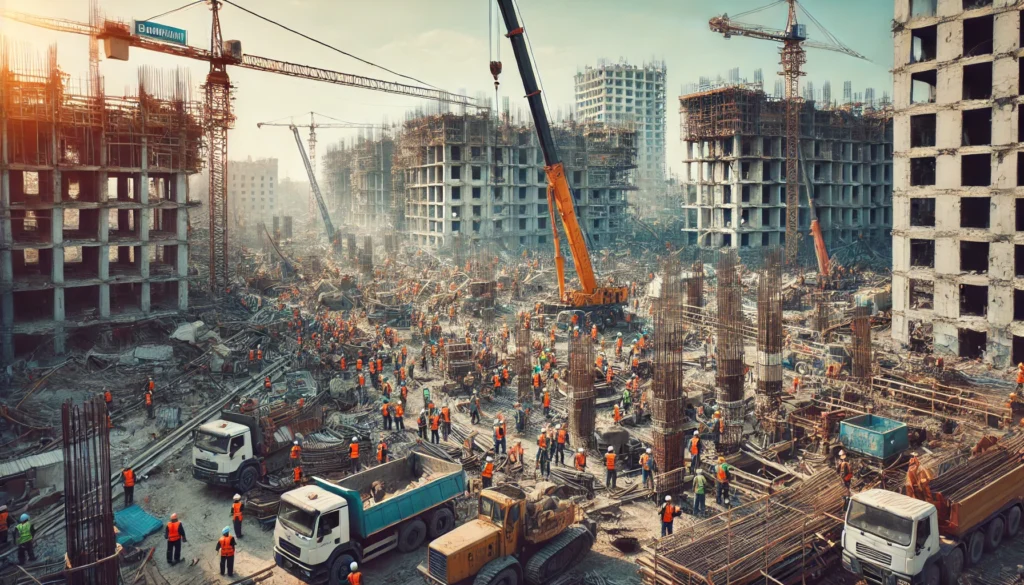
On June 27, 2024, the Kyiv School of Economics (KSE), initiated by the European Business Association, presented the results of the study “Structural Changes and Challenges in Ukraine’s Construction Industry: Analysis and Forecasts.” This study assesses the pre-war state of the construction sector and the impact of the full-scale invasion on it. Specifically, analysts examine the level of destruction of Ukrainian infrastructure and identify the necessary materials for its reconstruction.
According to the World Bank, the total cost of rebuilding and recovery in Ukraine amounts to $486 billion. To restore part of the infrastructure mentioned in World Bank reports, approximately $65 billion is needed solely for building materials. At the same time, the vast majority of the necessary building materials can be produced in Ukraine, which will help reduce costs, create new jobs, and increase state budget revenues.
Experts note that over 90% of the necessary building materials can be produced in Ukraine. Among the most important materials for reconstruction are cement, concrete, metal structures, bricks, glass, and thermal insulation materials. This will promote the development of domestic production capacities, which in turn will create additional jobs and support the economy.
“Current investments are crucial, but additional billions are needed to restore Ukraine’s infrastructure and economy. It should be noted that investments, in particular, will contribute to the development of domestic production capacities, creating new jobs and supporting the economy,” said Maksym Nefyodov, Director of Innovative Solutions at the KSE Institute.
Restoring infrastructure requires significant investments. In particular, the CRH group, one of the largest building materials manufacturers, has already invested $80 million in Ukraine’s construction sector during the full-scale invasion. The Irish company Kingspan plans to invest $300 million in the “Sírsa” project (Irish for Freedom), which involves the construction of a production campus in western Ukraine by 2026.
Ukrainian businesses are also actively investing in the construction sector. The development company City One Development has started building a glass factory in the Kyiv region, valued at €100 million. This is the only similar project in Ukraine after the previous plant was destroyed in 2014.
The study by the Kyiv School of Economics emphasizes the importance of rebuilding Ukraine’s infrastructure and the need for significant investments in this process. The use of domestic building materials, support for local producers, and attracting international investors are key elements for the successful recovery of the country.
The DOMOVA platform plays an important role in this process, offering unique solutions for uniting property owners and attracting investments. This will contribute to the development of the Ukrainian economy, the creation of new jobs, and the restoration of the housing stock.
After February 24, 2022, the investment climate in Ukraine underwent significant changes due to military aggression by the Russian Federation, leading to the emergence of new challenges for foreign investors. The war has become a serious obstacle to potential investments for several reasons. On the one hand, the presence of active military actions in the country evokes associations with high uncertainty and the risk of losing invested funds among international investors. On the other hand, the lack of a system to insure such war risks makes the investment environment less attractive for conducting and developing business in Ukraine.
With the aim of creating favorable conditions for attracting investments to Ukraine and stimulating the economic development of regions, the Parliament adopted the Law of Ukraine “On State Support of Investment Projects with Significant Investments in Ukraine”, amended and adapted to the conditions of martial law. The main task of the Law is to stimulate the attraction of strategic investors to the national economy by providing state support for large investment projects. Furthermore, from 2024, the Law concerning the insurance of investments in Ukraine against war risks has come into effect.
Restoration of investment demand
Nevertheless, the uncertainty caused by both the war in the country and market factors does not stop the development of the real estate sector. On the contrary, the sector adapts, considering new trends and consumer needs. A number of well-known advantages of investing in real estate, such as – predictable rental income, the tendency for asset values to increase, protection against inflation, and the growth of family capital, – are precisely the factors that have been effectively working for centuries.
At the start of 2024, the National Bank of Ukraine (NBU) reports that Ukrainians possess 764 billion hryvnias in cash, equating to nearly $20 billion in USD. And this is about savings only in hryvnia, which, by various estimates, make up a third of all savings – cash in dollars/euros, foreign currency deposits, government securities, that is, domestic government loan bonds in currency. According to the latest calculations by the NBU, this is more than $100 billion.
Despite the reduced investment demand compared to the pre-war years, the real estate sector is experiencing positive shifts, especially in the primary market. However, there are certain “buts,” including the washing out of liquid concepts of residential complexes (RC) and issues with construction dynamics.
The stability of investments in real estate also depends on the political and social conditions in the country. Government programs for the restoration of infrastructure and housing, such as eVidnovlenya and eOselya, the legislative base, as well as support for foreign investments, can serve as additional stimuli for the growth of the sector.

Demand for diversification and innovation
The demand for diversified real estate formats is growing. Apart-hotel formats managed by experienced operators are becoming increasingly popular, offering investors profitable business models with a service component. Such a product meets the needs for passive income and access to a comfortable life in a complex.
Current trends indicate a shift in consumer preferences. There is a growing demand for residential complexes with developed infrastructure, high levels of service, and environmental standards. This leads to an increased interest in investments in projects that meet modern requirements for sustainable development and comfort.
Diversity of investment opportunities
The real estate market offers a wide range of opportunities for investment: from purchasing apartments in new buildings to investing in commercial real estate and land plots. In conditions of volatility and uncertainty, long-term investments can offer more stable and predictable returns. This is particularly relevant for the real estate market, where prices can increase over time.
Diversification, quality of life, and innovative formats will be key factors that will determine the success of real estate investments in the near future. Investing in real estate remains an attractive option for preserving and increasing capital, adapting to changing conditions and market needs.