


Mission impossible? How to convince neighbors to sell a building together when everyone has a different view
How to align neighbors on a collective building sale: decision-making psychology, the financial logic of consolidation, and DOMOVA’s role in a structured negotiation process.

Collective sales of aging residential properties are always a marathon, not a sprint. When the future of an entire building is at stake, the primary challenge is not finding an investor or handling legal complexities — it is human communication. How do you align people who live in the past, fear the future, or are simply exhausted by uncertainty?
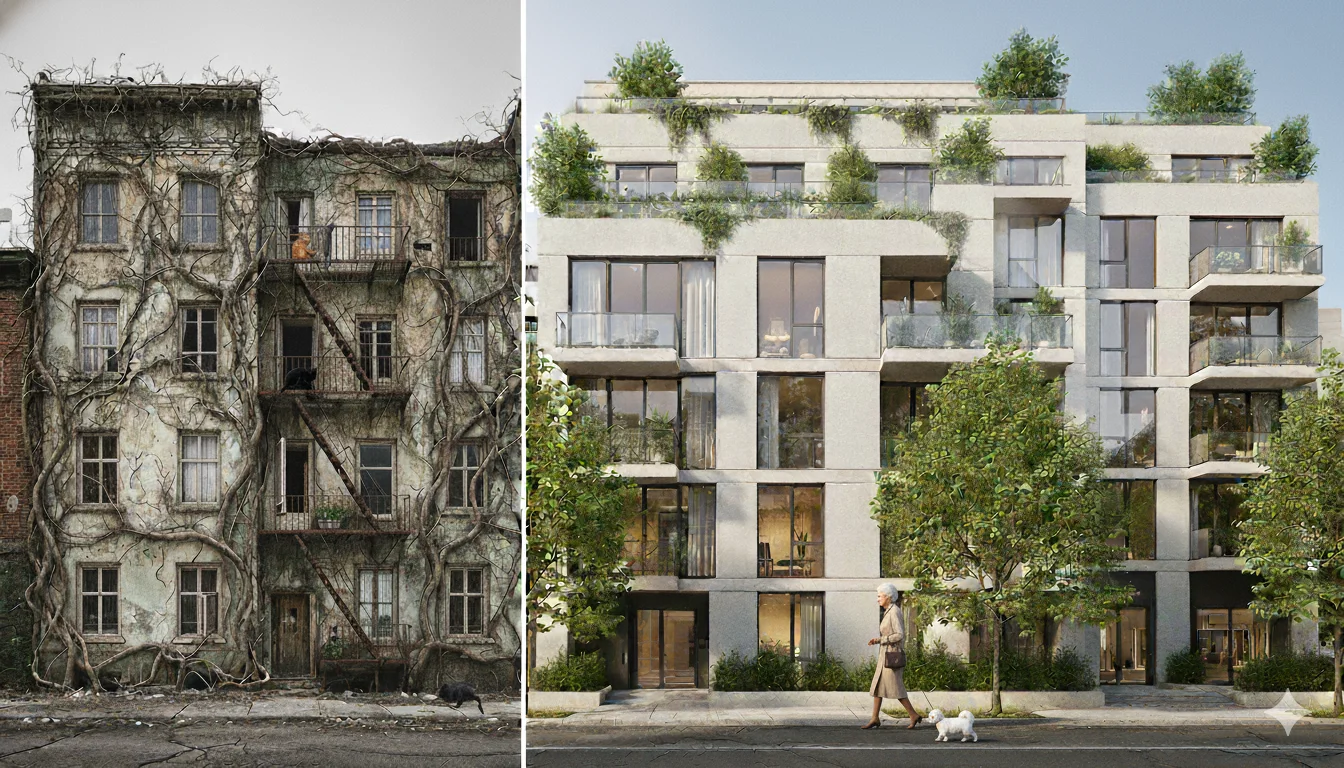
Imagine living in an older building in a desirable location. The structure is deteriorating, utilities are outdated, and heating bills are high due to a lack of thermal modernization. The market value of your apartment as a standalone asset is gradually declining, while the land beneath the building remains highly valuable. Financial logic suggests a clear move: consolidate with neighbors and sell the entire building to a developer for renovation at a 20–30% premium above individual market value.
Yet what appears rational in an Excel spreadsheet often encounters emotional resistance in real life.
Why neighbors say “No” — and it’s not just about money
It is misleading to assume price is the only obstacle. In times of the war and prolonged stress, people cling to stability — even if that stability is an outdated, deteriorating building. Psychologists refer to this as the endowment effect: we overvalue what we own and fear losing control.
Neighbors are not just co-owners of square meters; they are individuals with different life circumstances. For a retiree, the building represents memories and routine. For a young family that recently invested heavily in renovations, selling feels unreasonable — overlooking the fact that developers purchase location potential, not interior finishes.
There is also the “silent” category — owners who have moved abroad. Reaching them is difficult, and their willingness to make remote decisions is limited.
On the logic of decisions
We understand well how this process usually unfolds.
We start with conversations.
Our goal is not to persuade at any cost, but to understand what truly matters to each owner.
For some, safety is the primary concern. Aging structures, worn utilities, the absence of shelters and accessibility features represent real risks and daily inconveniences. For them, moving to more modern housing means stability and protection.
For others, the issue is financial. Some have relocated and do not plan to return. Others face ongoing repair costs due to structural failures and a gradual decline in property value. Selling the building as a consolidated asset makes it possible to obtain a fair market price and greater flexibility for future decisions.
Only after understanding the positions of the majority do we proceed to a general meeting.
Managing expectations
Discussing numbers is often the most challenging stage. Owners frequently rely on listing prices rather than actual transaction data, assuming their unit is exceptional.
A shift in perspective is essential: the sum of parts is often less than the whole. Selling a single apartment means competing in a saturated secondary market with limited demand. Selling the entire building enters a B2B environment, where investors evaluate land value and redevelopment potential. This is why consolidation creates a premium.
The rational approach focuses on net proceeds and purchasing power. In many cases, owners can acquire more modern housing — sometimes even larger — while retaining capital.
Transparency builds trust
The greatest barrier to a deal is distrust: “What if we are deceived?” “What if I sign and others don’t?”
This is why the process cannot rely on informal agreements.
DOMOVA acts as an independent facilitator and transaction coordinator. Transparent preliminary agreements, professional legal structuring, and clearly defined payment mechanisms reduce risks. The transaction proceeds only with unanimous consent, and funds are transferred individually.
Consolidating neighbors is complex social work requiring patience, empathy, and structure. Yet the outcome is meaningful: transforming an aging, inefficient asset into real capital.
This is not about losing housing — it is about creating new opportunities through collective action.
Do you have doubts about your property’s value? Request a preliminary investment assessment of your building through DOMOVA to rely on concrete figures rather than emotions.
Last News

2025 consolidated a new logic of Ukraine’s real estate market: the return of investor activity to Kyiv, a shift in demand toward quality and safety rather than the “cheapest square meter,” and growing interest in consolidated assets. The market has become more selective and rational, with pricing increasingly driven by asset readiness rather than location alone.

How Odesa is shaping its Development Strategy until 2027, why housing renovation is a priority, and how DOMOVA contributes to urban recovery.
Ukraine’s housing deficit has reached a historic scale — millions of apartments lost, and new construction covers less than 1 % of needs. Yet within this crisis lies opportunity: old buildings can become a new foundation for recovery through collective action and investment.