


Market of Resilience: key Real Estate takeaways of 2025
2025 consolidated a new logic of Ukraine’s real estate market: the return of investor activity to Kyiv, a shift in demand toward quality and safety rather than the “cheapest square meter,” and growing interest in consolidated assets. The market has become more selective and rational, with pricing increasingly driven by asset readiness rather than location alone.

The year 2025 marked a phase of “new normality” for Ukraine’s real estate market. While 2024 was largely defined by adaptation and the search for safe havens in the western regions, 2025 clearly signaled a return of investor interest to the capital and a stabilization of market rules. Based on a comprehensive annual report by LUN.ua, we have identified the key trends that will shape property values in the near future.
Kyiv regains its position as a key investment market
In 2025, Kyiv once again became one of the country’s core real estate markets for investors. Compared to 2024, activity shifted back from western regions to the capital, which was reflected in secondary market indicators:
- One-bedroom apartments: median price increased by 13% year-on-year to USD 68,000
- Two-bedroom apartments: up 11% (to USD 109,000)
- Three-bedroom apartments: up 14% (to USD 160,000)
This growth outperformed returns on foreign currency deposits, reinforcing real estate’s role as a capital preservation instrument. At the same time, the market has become increasingly selective: buyers are willing to pay a premium for safety (lower floors, underground parking used as shelters) and overall quality, while overpriced units without renovation are often ignored.
eOselia as the main driver of the primary market
The state mortgage program has effectively prevented stagnation in the construction sector. According to LUN data, in 2025 the program became particularly active in the primary market.
- Scale: 114 developers were accredited
- Result: more than 4,300 transactions (over half of all issued loans) were related to newly built or under-construction properties from developers
This sends a clear signal: demand remains solvent but highly dependent on access to financial instruments. For owners of older housing stock, this means stronger competition from new developments now available under preferential mortgage terms.
Price polarization: economy class declines, comfort class grows
A clear polarization can be observed in Kyiv’s primary market:
- Prices per square meter in the economy segment have declined or stagnated
- Comfort and business class projects continue to show steady growth
Investors are no longer chasing the lowest price per square meter. Priorities have shifted toward reliability, construction quality, and project readiness. Buyers are increasingly willing to pay more for infrastructure and energy independence, leaving outdated projects behind.
Regional imbalances persist
Although Kyiv has strengthened its position, the western vector remains strong.
- Lviv retains the highest new-build prices (USD 1,300–1,500+ per sqm, depending on class), surpassing even some Kyiv indicators
- In Uzhhorod, housing affordability has improved (prices grew more slowly than wages), yet the city remains among the three most expensive
- Odesa recorded a deterioration in its housing affordability index (+2%), indicating that prices are rising faster than local incomes
Rental market: investors target entire buildings
Rental prices stabilized in 2025, with no sharp fluctuations observed. In Kyiv, rental rates leveled off, although housing in safer western regions remains significantly more expensive.
More importantly, large investors have changed their strategy. Rather than purchasing individual apartments for rent, they are increasingly focused on acquiring entire buildings for apartment hotels or income-generating residential projects. For owners of older properties, this represents a clear opportunity: a centrally located aging building can become a strong foundation for such investments. Platforms like DOMOVA are where investors actively seek turnkey acquisition opportunities.
For property owners
The year 2025 demonstrated that the market is alive and evolving, but it has clearly shifted toward the buyer. Today’s buyer is data-driven and highly selective about quality. Selling “just walls” is becoming increasingly difficult. Those who succeed are offering either a ready-to-use product, a liquid location, or— as in the case of DOMOVA projects — a consolidated asset with a clear investment rationale.
The market has changed. Does your property price reflect the realities of 2026? Request a professional valuation and asset potential analysis on DOMOVA.
Last News

How to align neighbors on a collective building sale: decision-making psychology, the financial logic of consolidation, and DOMOVA’s role in a structured negotiation process.

How Odesa is shaping its Development Strategy until 2027, why housing renovation is a priority, and how DOMOVA contributes to urban recovery.
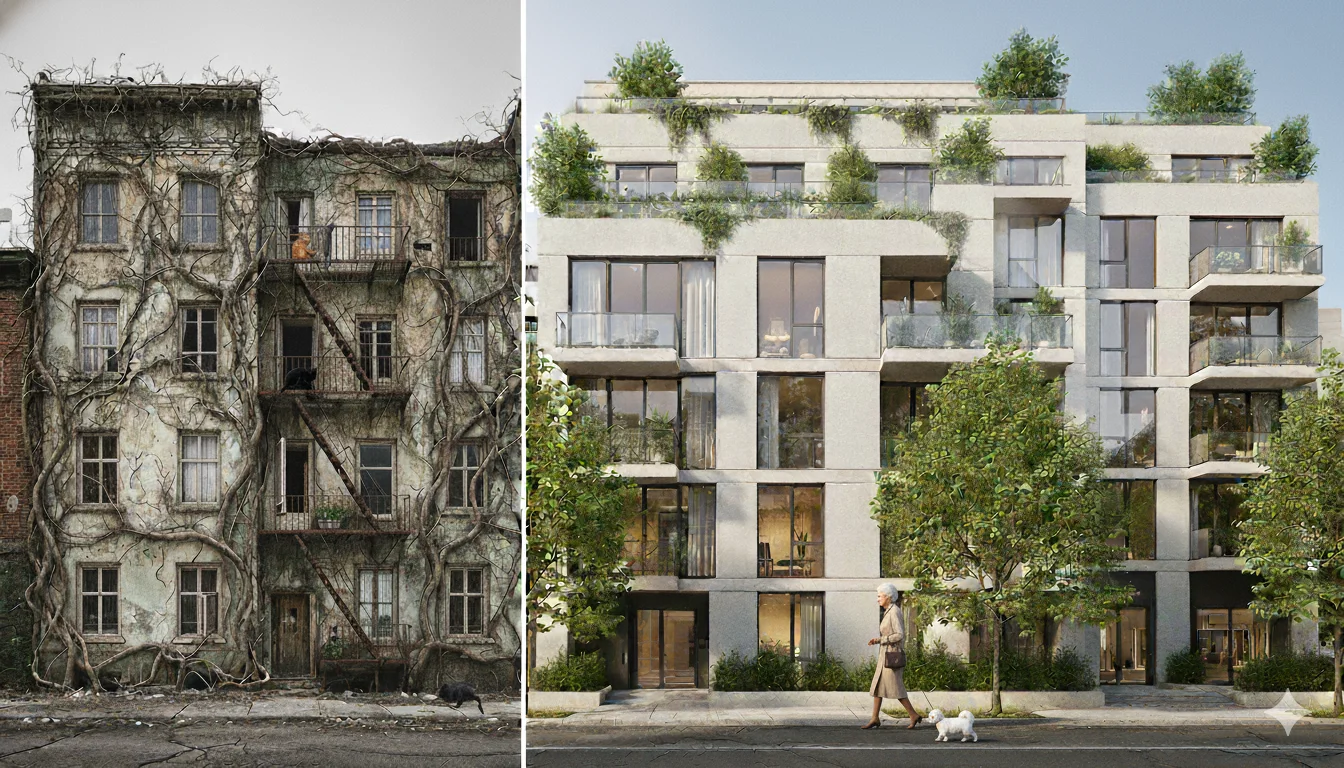
Ukraine’s housing deficit has reached a historic scale — millions of apartments lost, and new construction covers less than 1 % of needs. Yet within this crisis lies opportunity: old buildings can become a new foundation for recovery through collective action and investment.