


To ensure that everyone can coexist comfortably in society and have equal opportunities to access parks, homes, schools, hospitals, cafes, shops, etc., it is essential to consider the specific features and needs of all categories of citizens.
The UN Convention on the Rights of Persons with Disabilities, ratified by Ukraine, declares the principles of equal opportunities, non-discrimination, and respect for human dignity, the freedom to make one’s own choices, and independence. This applies to individuals who experience difficulties in independent mobility, receiving services, obtaining information, or navigating spaces, such as people with disabilities (those with visual, hearing, or musculoskeletal impairments), the elderly, pregnant women, individuals with temporary health issues, and those with strollers. They have equal rights to access all public facilities. For their rights to be realized, buildings and structures must be adapted and accessible; otherwise, all discussions about equality and inclusivity become meaningless.
Buildings and structures that meet the regulatory requirements for ensuring accessibility and safety for people with limited mobility are considered accessible. This is achieved through the implementation of comprehensive architectural and planning, engineering and technical, ergonomic, constructional, and organizational measures. There are two main blocks of building accessibility for people with limited mobility: informational and architectural.

Informational accessibility includes the ability to freely obtain information about an object, and navigate within it and in the surrounding area: information boards, signs (both regular and in Braille) for people with limited mobility, and traffic lights equipped with sound signals. This allows a person to independently understand how to enter and exit the building.
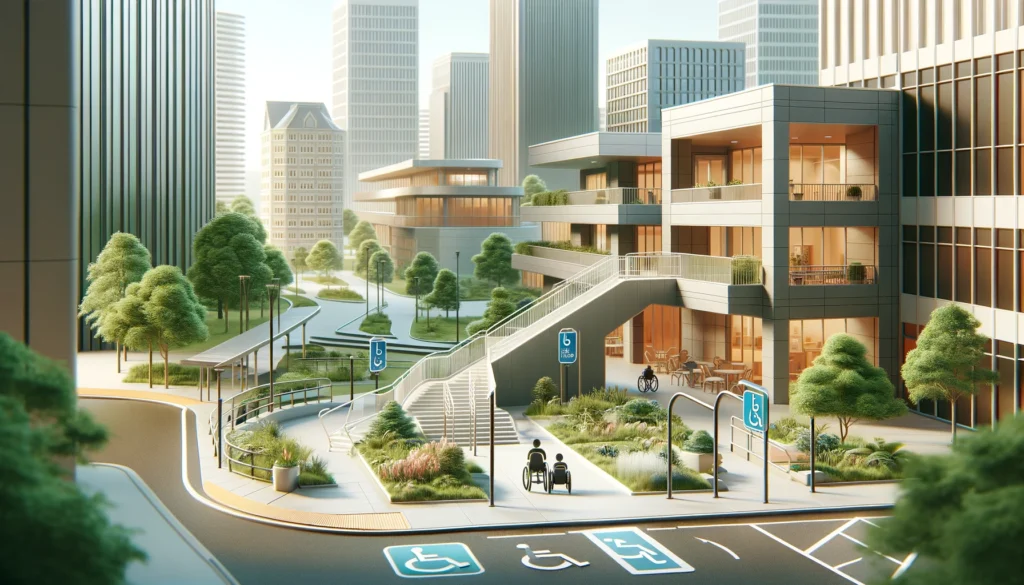
Architectural accessibility involves the direct adaptation of buildings for use by people with limited mobility: the presence of ramps, lifts, and similar features. Information about architectural accessibility should also be conveyed through informational accessibility.
Architectural accessibility is ensured through universal design or reasonable adaptation of existing buildings. The principles of reasonable adaptation allow for the provision of a minimum standard of accessibility during the reconstruction, restoration, major repairs, and technical re-equipment of residential buildings and public facilities. These measures may include ramps, lifting devices, and other mechanisms.
LUN City, in collaboration with students from Taras Shevchenko National University of Kyiv (KNU), conducted a study on the level of architectural accessibility of residential buildings in Ukraine. As part of the program, about 1000 residential buildings were studied in 23 cities across Ukraine, including Odesa and Kyiv.
In Kyiv, only 30% of the surveyed buildings have ground-level entrances, and a compliant ramp (with a slope of 3-5 degrees, a width of 1.2 meters, with handrails and a non-slip surface) is present in only 9% of buildings.
Regarding access to shelters: only 3% of shelters have a wide entrance and a compliant ramp, and only 8% have a restroom, with none having restrooms for people with disabilities. The overwhelming majority of buildings do not have equipped shelters, and people use parking lots during air raids.
On August 22, 2023, the President of Ukraine, Volodymyr Zelensky, signed an important law on the mandatory provision of bomb shelters in new buildings. Earlier, on August 10 of the same year, the norms DBN B.2.2-5:2023 were approved, which regulate the construction of civil protection structures.
According to the new norms, underground parking and other premises must be adapted for sheltering people and be barrier-free. There should also be safety rooms on the floors, and the building must have fire-resistant walls and windows. These regulatory acts are intended to ensure the protection of the population under threat and influence the approach to construction and the provision of communal services.
In 2023, the Ukrainian real estate market went through a real test period due to the destabilization caused by the war. The research conducted by LUN Agency shows that interest in buying apartments remains at a fairly high level – 70-80% of the pre-war level.
Among the regions far from the fighting, there is an increase in prices on the secondary market, even in currency terms. In contrast, Kyiv has seen a 3% decline in the cost of one-bedroom apartments, while in Lviv and Ivano-Frankivsk, prices have risen by 12% and 18%, respectively.
What is the situation in the primary market? Although developers have resumed the work of sales departments, the pace of construction has slowed significantly. This resulted in a 15% decline in new housing starts in Kyiv, 35% in the Kyiv region and 38% in Lviv. This situation may lead to a shortage of new apartments, which is especially important in the context of the preferential mortgage program eOselya.
In the spring of 2023, the demand for apartment purchases stabilized, indicating a gradual return of the interest in investing in housing. The government program eOselya, which provides preferential lending terms, also helps to stabilize market confidence.
Odesa, one of Ukraine’s key cities, has also seen changes: prices for two- and three-bedroom apartments are up about 1%, while prices for one-bedroom apartments have dropped by 1%. The highest prices are observed in Prymorskyi and Kyivskyi districts of the city.
Overall, 2023 is characterized by a gradual recovery in the real estate market. Demand is focused on finished housing, as such investments are considered less risky. However, a slowdown in construction and uncertainty on the frontline could lead to a housing shortage.
The primary market is seeing growing interest in apartments. Real estate experts say that important criteria for choosing a property are its liquidity, the developer’s reputation, and the current state of construction. They also predict a 15% increase in prices in the primary market in hryvnia in early 2024 and stabilization in the secondary market with an increase of 6-10% in dollars.
The speed of project implementation by developers depends on the state of Ukraine’s financial sector. Returning to the January 2022 figures will require significant time and effort. Currently, the Ukrainian economy remains stable thanks to strong support from Western partners and allies.
The consumption sector continues to recover, but investment activity declined significantly in the second half of 2023. Financial experts see the potential for economic growth through exports, despite the attacks, thanks to the operation of the sea corridor from southern ports.

According to the Forbes, experts point to a clear signal that the budget deficit is unlikely to widen in 2024. There is a high probability that investing in real estate as a way to preserve capital will become popular again this year. It is noted that approximately $15 billion is on hryvnia deposits, $11 billion is on foreign currency deposits. A report by the National Bank of Ukraine indicates that between $60 and $100 billion is held in cash by households.
Today, the market has recovered about a third of sales compared to the pre-war period, which is a positive message. At the same time, dollar inflation poses risks, but buying real estate can protect against inflationary losses, which is one of the reasons why people continue to invest their free money in real estate.
Experts also predict a new approach to construction and the launch of new projects. One of the innovative approaches to solving the problem of emergency housing and reconstruction was demonstrated by the Ukrainian platform DOMOVA. DOMOVA positions itself as the world’s only IT platform that provides apartment owners in old and dilapidated buildings with the opportunity to unite to sell the entire building together.
The company provides convenient and transparent mechanisms for such an entity, offers a free sale request, and attracts investors and construction companies.
Black Swans always bring not only changes but also new solutions.